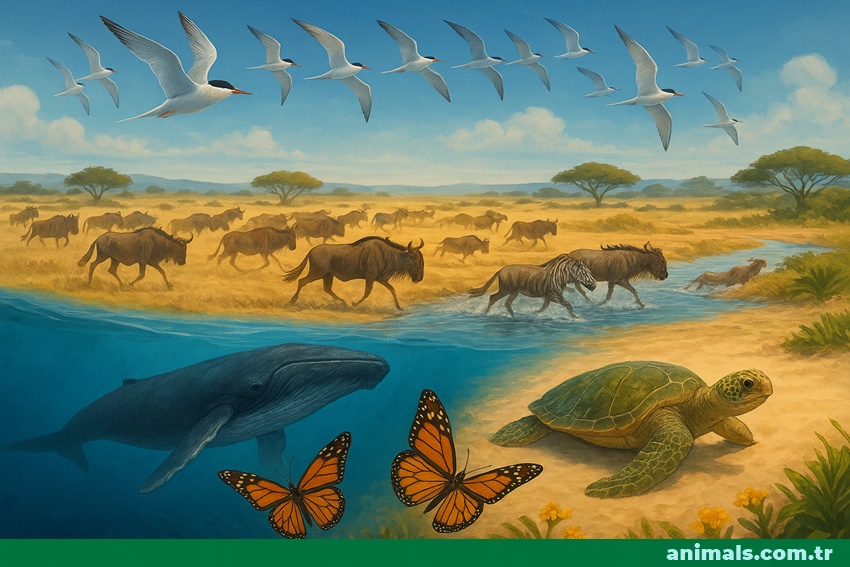
Animal Migrations The Longest and Most Dangerous Journeys on Earth
Animal migration is one of the most impressive natural events on the planet. It is not a simple trip from one place to another.
It is a survival strategy shaped by climate food availability breeding needs and ancient instincts that guide animals across oceans continents and skies.
These journeys can span thousands of kilometers and push each species to its physical limits while revealing how deeply connected the world’s ecosystems are.
Many birds travel astonishing distances each year.
The Arctic tern completes the longest known migration of any animal flying from the Arctic to Antarctica and back again.
This small and lightweight bird can cover more than seventy thousand kilometers in a single year.
It follows global wind systems to conserve energy and uses its remarkable sense of direction to stay on course even through storms.
Its migration helps balance populations of fish and insects across regions and shows how sensitive birds are to changing climate patterns.
Large mammals also take part in massive seasonal movements.
Wildebeests in East Africa travel in huge herds across the Serengeti and Maasai Mara in search of fresh grass and water.
Their journey is dangerous because predators such as lions and hyenas wait at every stage.
River crossings are the most dramatic moment because strong currents and crocodiles make survival uncertain.
This migration supports the entire savanna since grazing patterns help regenerate grasslands and maintain the balance between predators and prey.
Marine animals face challenges in a completely different environment. Humpback whales migrate from cold feeding grounds to warm breeding waters.
These giant animals travel thousands of kilometers guided by sound memory and temperature cues.
Along the way they must avoid ship traffic noise pollution and fishing nets.
Their migration ensures the survival of calves that need warm and calm waters during their first months of life.
It also helps circulate nutrients in the ocean because whales redistribute food sources across regions during feeding and diving.
Sea turtles show another form of extreme navigational ability.
They travel across entire oceans and return to the same beach where they were born.
Scientists believe they use Earth’s magnetic field as a natural map.
Their journey is extremely risky because young turtles face predators and human threats such as light pollution which disrupts their orientation.
Each successful migration contributes to the health of coral reefs and seagrass meadows since turtles help maintain these habitats.
Insects may be small but their migrations are equally remarkable.
Monarch butterflies travel from Canada and the United States to Mexico.
They complete this journey over generations because no single butterfly makes the full round trip.
Each group continues where the previous one left off following the sun and temperature changes.
Their migration supports flowering plants and pollination networks that keep many ecosystems alive.
Animal migration reveals how every journey is connected to the stability of our planet.
When climate change disrupts temperatures rain patterns and food sources these migrations become harder and sometimes impossible.
Protecting migration routes preserving habitats and reducing pollution are essential steps to ensure that these incredible journeys continue.
Across land sea and sky migration is a story of endurance intelligence and instinct.
It shows that animals do not move alone.
Entire ecosystems move with them and the world stays in balance because of these long and dangerous journeys.
animal migration,long distance animal journeys,wildlife migration routes,Arctic tern migration,
wildebeest migration,humpback whale migration,monarch butterfly migration
sea turtle navigation,ecosystem balance,Animals.com.tr wildlife articlesanimals,anima,wildlife articles
animals article,wildlife articles